





Selected work / Engineering stack / Field notes / Connect ↗
Software engineer · Cybersecurity student · DeFexGG
I build across abstraction layers: Windows kernel research, driver-aware desktop software, technical search infrastructure, and interactive web experiences. Studying Cybersecurity at Khmelnytskyi National University.
The common thread: understanding what happens beneath the interface—and making that complexity useful above it.


01 / SYSTEMS → 02 / TELEMETRY → 03 / RETRIEVAL → 04 / EXPERIENCE → 05 / MOTION
Understand the machine beneath the application.

A Windows kernel engineering research suite spanning driver communication, memory management, PE loading, and user-mode tooling. The repository includes kernel C sources, a C++ loader, and a manual mapper.
C C++ WDK / MSVC Windows internals
Explore the repository ↗ · Kernel source · PE mapper
Companion research → Kernel Spyglass
Kernel Spyglass connects a Python/PySide6 analysis interface to a Windows VM through a PowerShell agent. C kernel components explore process visibility, filesystem filtering, callbacks, and integrity monitoring.
The interesting boundary is between kernel events and defensive visibility: driver-level observations become a searchable, source-labeled activity log in the host interface.
C C++ Python PySide6 / QML PowerShell
Kernel and security projects are research work intended for isolated, explicitly authorized environments.
Low-level signals. A clear, considered interface.

A driver-aware Windows system monitor combining native OS counters, hardware sensors, and a custom kernel telemetry channel. Animated Avalonia views, configurable CPU widgets, a desktop overlay, and SQLite history bring the data into focus.
C# .NET 10 Avalonia C driver WMI SQLite
Explore the repository ↗ · Releases · Telemetry services
Engineering detail → startup is a data contract
The boot sequence waits for two consecutive complete telemetry samples, rather than revealing the dashboard after an arbitrary timer. Native counters, sensor availability, and the driver channel determine readiness.
Full kernel telemetry has a documented hardware-support matrix; the repository does not claim universal Windows hardware compatibility.
Technical search that keeps its sources attached.
A PostgreSQL-backed technical knowledge base and MCP server for systems and reverse-engineering research. Exact identifiers, lexical search, and vector similarity feed reciprocal rank fusion; extracted entities retain document and line-level provenance.

Python PostgreSQL 17 pgvector / HNSW GIN RRF FastMCP
Explore the repository ↗ · Retrieval implementation · MCP server
Engineering detail → preserve structure before retrieval
The ingestion pipeline preserves Markdown heading ancestry, code blocks, and tables. A domain-specific extractor identifies technical entities such as IOCTLs, WMI classes, and native APIs. Evidence includes source paths, heading breadcrumbs, line ranges, and verbatim excerpts.
The goal is useful retrieval with inspectable evidence—not an unsupported promise that an AI system can never hallucinate.
Architecture, made interactive.

A bilingual PL/EN frontend showcase with a real-time Three.js facade configurator, an itemized PLN estimator, and material-led editorial design. Four procedural building models connect design choices to budget exploration.
TypeScript Next.js 16 React 19 Three.js / WebGL GitHub Pages
Open the live experience ↗ · 3D studio · Source
Fictional architectural brand; conceptual projects and indicative estimates, not completed client work.
Engineering detail → interaction beyond the landing page
- Connected tools: configurator choices carry through to the estimator.
- Progressive fallback: a functional, explicitly labeled 2D alternative when WebGL is unavailable.
- Localization: equivalent Polish and English routes preserve selections.
- Verification: pricing tests and browser checks cover interaction, responsive layouts, accessibility, and actual WebGL pixel changes.
A small surface with useful depth.
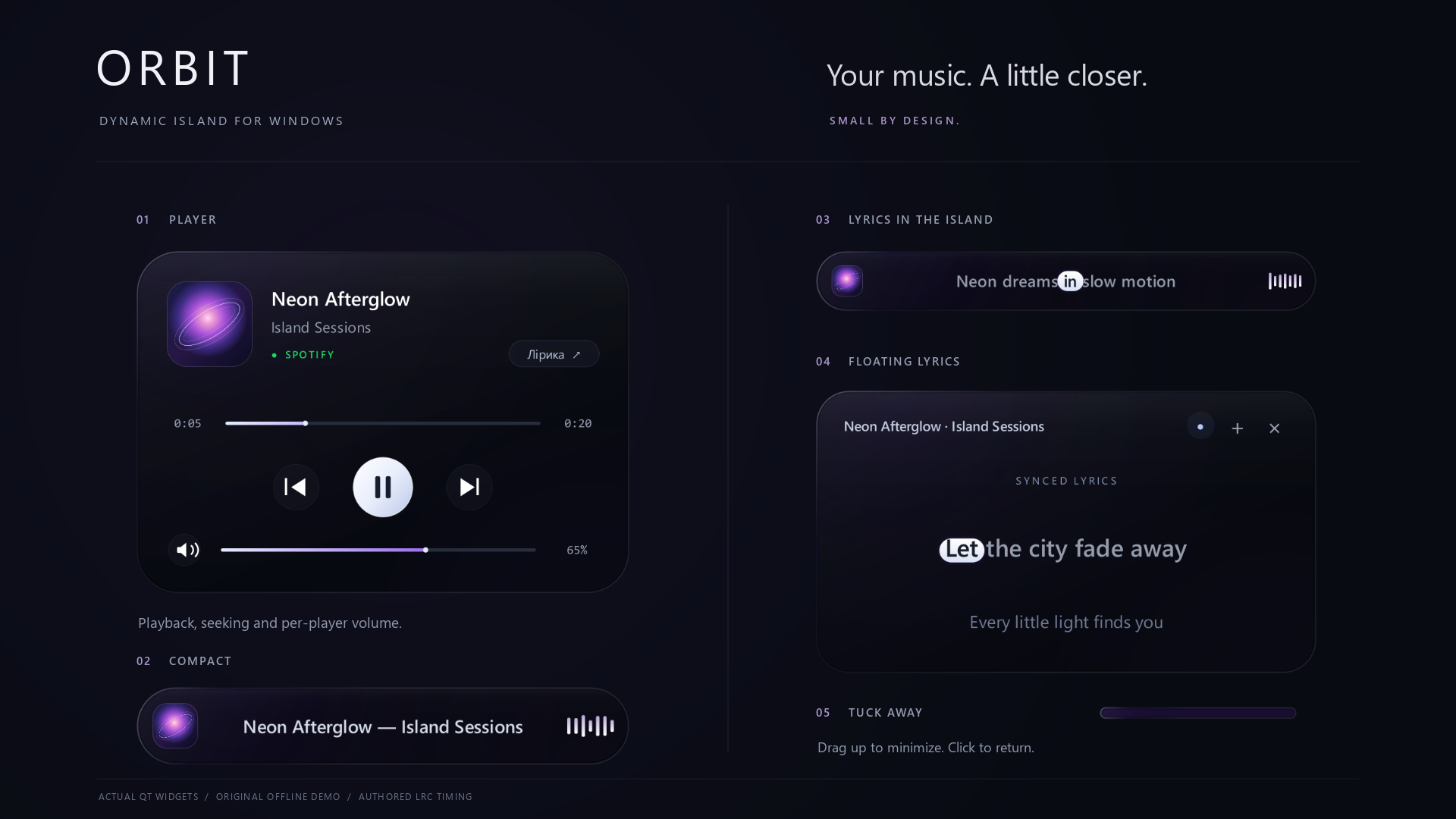
A Windows music island with media-session playback controls, per-player Core Audio volume, synchronized lyrics, and interruptible spring motion. Custom-painted PyQt6 surfaces keep the experience compact and cohesive.
Python PyQt6 Windows SMTC Core Audio LRC lyrics
Explore the repository ↗ · Watch the film · Motion tests
Play the motion study → animated preview
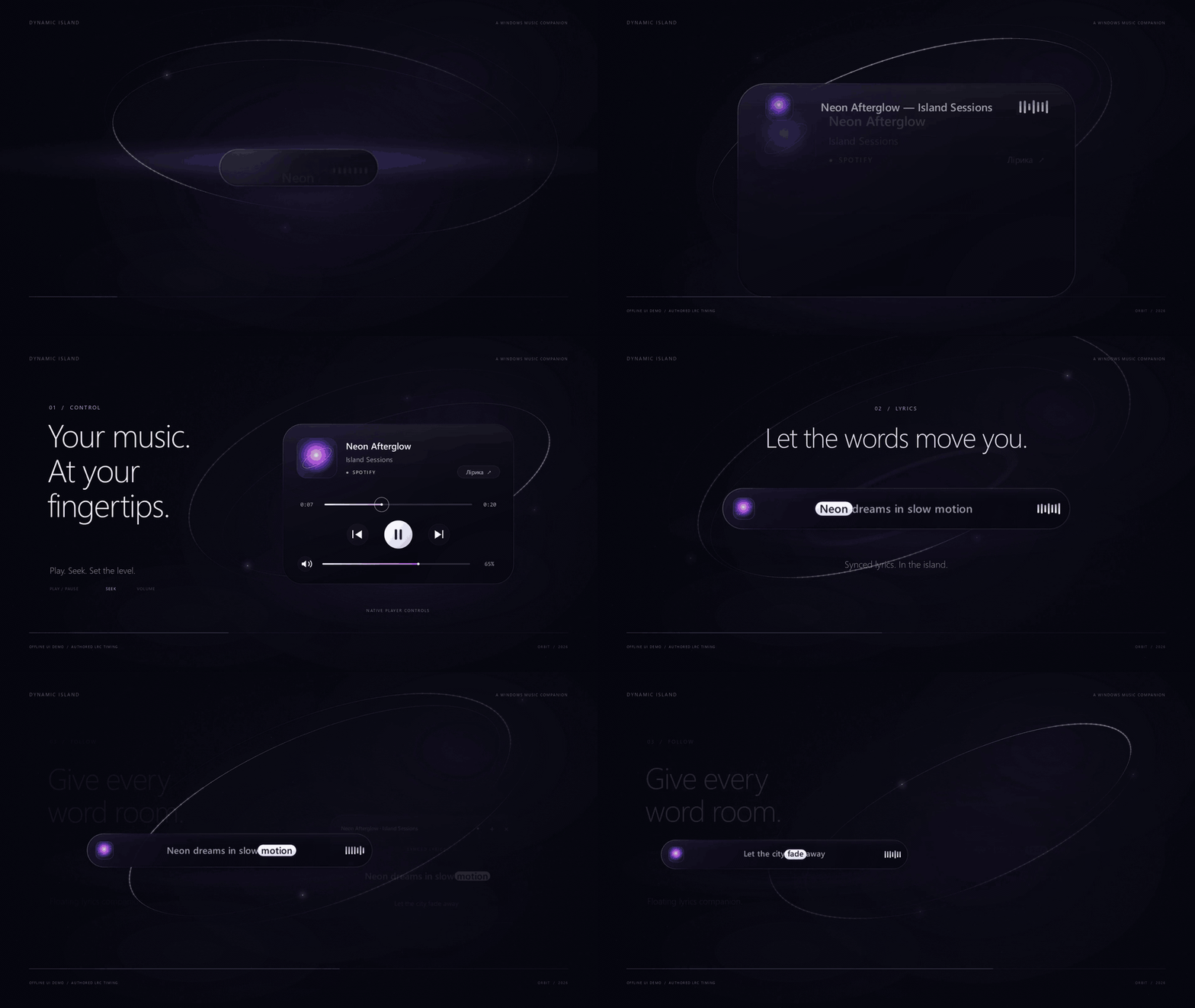
The showcase uses real application widgets with authored offline demo metadata and lyrics. The waveform is decorative, not audio analysis. Orbit is a source release; no prebuilt application installer is implied.
Tools in context, not a wall of logos. Each group links to a project using it.
- Systems & research: C · C++ · WDK · MSVC · Windows internals · PE structures
- Desktop & telemetry: C# · .NET · Avalonia · XAML · WMI · SQLite
- Python & native UI: Python · PyQt6 · Windows media sessions · Core Audio
- Retrieval & tooling: PostgreSQL · pgvector · hybrid search · entity extraction · MCP
- Web & interaction: TypeScript · React · Next.js · Three.js · Playwright · GitHub Actions
- Android & reverse engineering: Dear ImGui · JNI · IL2CPP · OpenGL ES · Zygisk
More of the workspace → web, automation, and native experiments
- Instalyzer — Python/Streamlit profile-analysis dashboard with session-isolated jobs and downloadable reports.
- Jutsu Remote — Android client and host tooling for remote device administration.
- Helensi Reader — web-based book reader.
- CTF Site — Astro-based security web project.
- ImGui Calculator — native calculator with Dear ImGui and embedded font resources.
- Personal portfolio — React and TypeScript web portfolio.
Explore the work. Open the source. Start a conversation.
Live work ↗ / LinkedIn ↗ / GitHub ↗ / Extera Project ↗
SYSTEMS / SIGNAL / SURFACE
Build useful software. Understand the systems underneath it.